THE EDGE OF THE CITY (in collaboration with Wonne Ickx (B), 2004 – 2009)
Since 2008, more than half of the world’s population is living in cities.
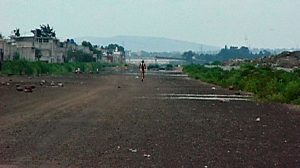
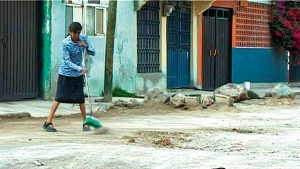
We were looking for people living at the edge of Mexico D.F. , a city that is called ‚endless‘. Most of them considered themselves not as being on the edge but rather in the center …
SD Video, PAL. colour, stereo, 30‘39‘‘, 2007 english / spanish, english subtitles
Since 2008, more than half of the world’s population is living in cities. The project „The edge of the city“ started 2004 as a cooperation with urbanist Wonne Ickx (Be/Mx) and became an audiovisual (re)search of the edges of Mexico City. We focussed on the people and their conditions of living there. The video combines different styles of storytelling, oscillates between documentary and essay.
It was the startingpoint for a series of works dealing with the idea of an endless cityscape.
The Edge of the City – text by Ruth Estévez
Stefan Demming’s artistic practice is a practice of travel. In his work he fosters the observation of daily scenarios to narrate different kind of human adventures. Throughout his voyages, the artist is recording with his video camera his appeal to moments and landscapes emphasizing concrete situations, which become in the very process of documentation independent and unique accounts.
By using maps and imaginary routes, Demming searches for places and spaces, where he sometimes takes their more obvious and literal function while other times he metaphorically alters their order, constructing adventures which give inner sense to what’s been previously recorded; it is this same sense that the traveler transforms his actions into epic poems regardless of the triviality of the facts exposed.
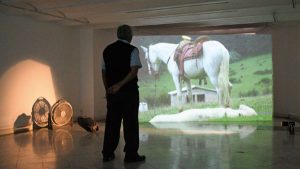
The exhibition entitled El límite de la ciudad (The Edge of the city) is based on the artist’s documentary with the same name, filmed in 2004 while visiting Mexico City. The video oscillates between document and fiction in order to narrate Demming‘s trip with urbanist Wonne Ickx, in search of the unpredictable limits of the metropolis.
From the start, there is no intention of revealing the actual limits of the city. Rather, the artist chooses to fantasize about the mysterious limits that appear to be never ending. This way all the research turns into a novel, moving towards a theme of the protagonists’ travels and adventures while at the same time revealing the conditions of survival based on the improvised reality that surrounds them.
To achieve the task, the artist becomes an ambiguous mixture between traveler and cartographer (a concept that may seem contradictory at first). The journey1 (something the cartographer doesn’t trust, even to the point of hating it) will be constructed from an imaginary relationship between the gaze and the landscape, camouflaged by the intention of finding the geographic demarcation of the city.
Throughout various interviews conducted in random encounters with strangers, the artist receives some kind of confirmation regarding the supposed limits of the city, which he then decides to disregard in an attempt to keep them unknown. Demming prefers to contemplate (in an almost Baudelaire-esque2 fashion) the urban horizon, marking a subtle difference between everyday functionality and the creation of myths.
It is through these excerpts that the exhibition reviews moments (personal anecdotes or stories told by others), spaces and daily activities that together reveal the possibility of urban boundaries.
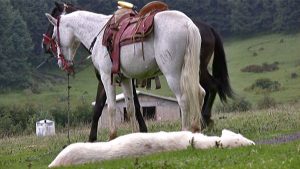
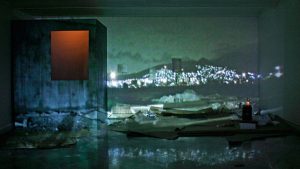
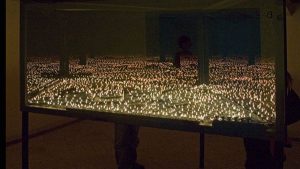
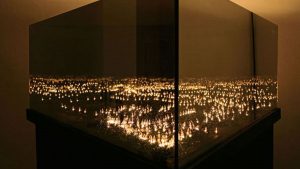
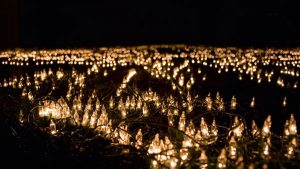
Simulations, almost theatre sets- videographical or sculptural- which allow the optical illusion of the infinite, the structuring of the unimaginable and above all, the feeling of uncertainty and instability that comes with this changing geography.
Ruth Estévez
1 The notion of “a journey” is forged as one in the romantic sense of 19th century travelers, where the “real landscape” (perceived as something controlled and humanized) is replaced by the “sublime landscape”, which excites and provokes surprises or wonder.
2 Contrary to the first German Romantics where the poetic landscape was primarily constructed from nature, Baudelaire’s poetic landscape could have only been the city, the 19th century metropolis and its anonymity, its size and its misery.
HD-video on BLU-RAY, 29’20’’, Pal, colour, stereo 2009
Language: Lowgerman, English, Pidgin; english subtitles
Sister Bernard Overkamp was a missionary sister in Papua New Guinea from 1968 until 1993. After 25 years she stopped her mission there because she thought the local sisters could do even good without her and she „didn’t want to be a hindrance for they cannot live their own culture.“
Since the year 2000 she and her colleague sister Dorothy are travelling with a circus in the USA. As an employee she takes care for the costumes of the female dancers. She and sister Dorothy want to be among the people and accompagny them. They call it a „ministry of presence“.
The video has been shown as a part of an installation project in public space: in camper that’s part of THE SMALLEST SHOW OF THE WORLD 2. By this, the story of the two nuns is brought back on the road and to the people.
Agriculture in Europe has changed a lot within the last decades and years. Like with other plants, the harvest of corn is done with big machines. A girl with a microphone gets lost in the cornfield. A farmer looks at his plants. They are all in a cornfield, the parallel montage evokes some dramatical stories, but the film is mainly about observing the harvest and the change of the landscape.
Dialogues:
(Elderly farmer from the off in Low-german)
This belongs to the farm of
Borkmann and is rented out.
There is also no follower
on that farm.
The main house is rented,
some families live there.
At last everything is changing
in the farming business …
The harvest has been accompagnied with a camera and besides the big machines, I started to film the camera assistant who enjoyed listening to the sound of a cornfield for the first time. If you have ever been in a cornfield you can imagine that it’s not always easy to find your way out – it’s like a djungle! However, the sound of the big harvesting machines cannot be overheard, unless you’re completely into something else…
A motivation for making the video was to document the big change of the landscape: while from midsummer on, you cannot see very far anymore due to the highth of the corn, after the harvest you suddenly can look very far. Suddenly, you see farms and a horizon where there used to be a „green hell“ like some people say. Allthough corn as a plant has only been cultivated since 50 years in the region Münsterland (close to the dutch border), it nowadays covers about 50% of the surface of the region. This is due to the growth of animal production: stables with hundreds of cows or even thousands of pigs need a lot of food! As still new stables for even more animals are being built, it is harder to get land for growing food for a farmer. And renting land has become more and more expensive of course. As a consequence, farmers need to expand or quit farming. Invest or stop. The number of farmers decreased a lot wihtin the past decades for different reasons. But the growing concurrence within an industrialized agriculture makes the farmers become ‚agro managers‘.