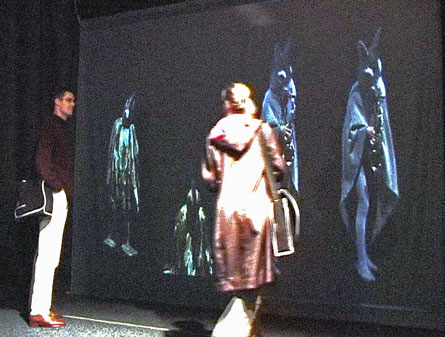
At a crossroad in Poland pigeons and people start to tremble in repetitive loops: a series of single frames in fast repetition with only small variations. You are at the red light: „Please wait!“
At a crossroad in Poland pigeons and people start to tremble in repetitive loops: a series of single frames in fast repetition with only small variations. You are at the red light: „Please wait!“

Music: Brigitta Muntendorf
A tourist is posing for the image at different places in a village by the seaside. Finally something happens, a drowning girl and a rescuer with a mask play a role in fragments of a story.
Depending on the amplitude of the music, the image is constantly cut into stripes of changing sizes.

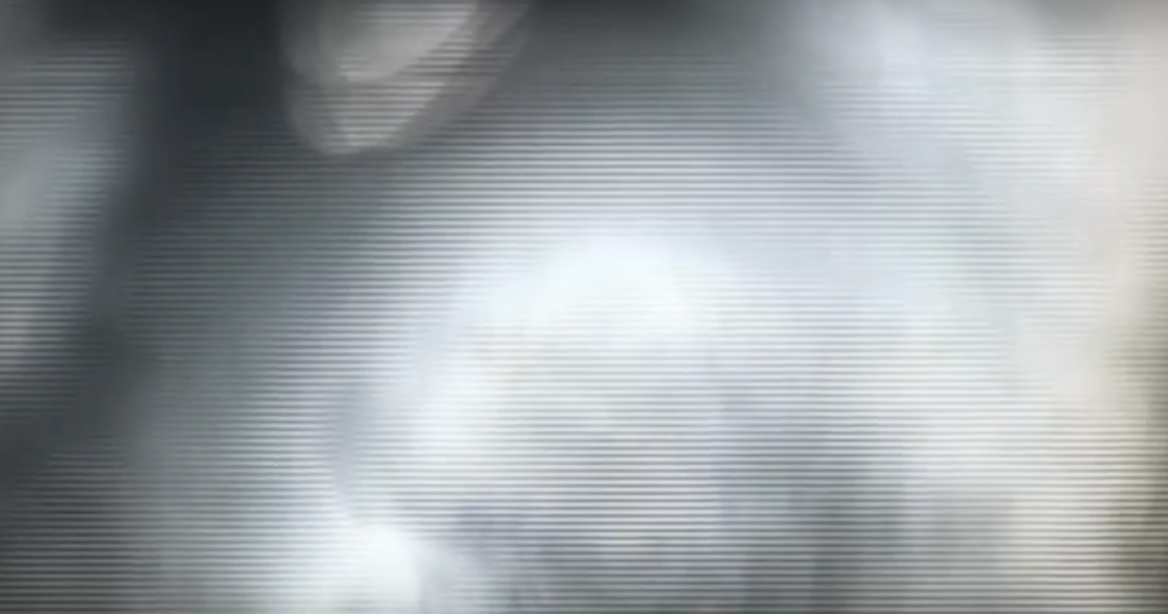
The video Weltuntergang shows a thunderstorm through an open window. The lightnings are edited in a way that they appear quickly after each other. In addition, there‘s artificial photoflashes that illuminate the inside of the room. The flashes cause interferences that make the image on a crt display seem to tremble. When printed as a still image, this creates light stripes.

SD Video, PAL. colour, stereo, 5‘02‘‘, 2009
Based on the film „Les parapluies de Cherbourg“ by Jacques Demy (1964) an audiovisual composition evolved that reduces the narrative elements of the original movie by turning short sequences into transformative loops. As all dialogues in the original were sung, the repetitions create melodic rhythms. In synchronized beats, the sampling of the sound goes along with the visual rhythm of the composition. The actors look like virtual singing sculptures and the grammar of the movie can be examined.
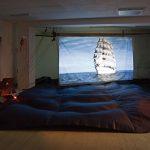
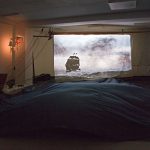
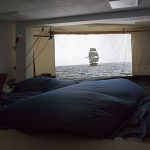

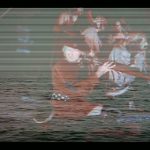
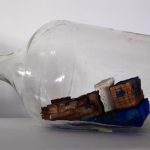
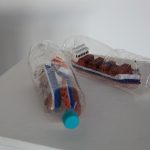
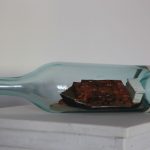
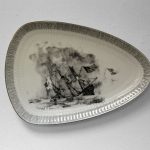
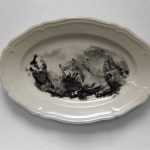
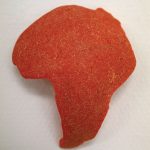
The seesaw chamber – scenarios of the sea (original title: Schaukelkammer)
mixed media installation, 2011
mixed media, 6 channel audio, light controllers, 1 video projection, 1 computer with custom software, 1 video loop on a monitor.
DOWNLOAD CATALOGUE „Szenarien der Meere“ (deutsch/german only)
The seesaw chamber combines cinematic orchestrations and arranges it in rhythmic structures that correspond to different events in the space.
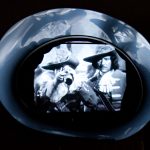
Depending on the film footage the mood of the soundtrack is changing and by this evoking cliché-like topics of old seafare movies where it comes from. Simultaneously to actions in the projected images, the space is animated: a winch is driven and makes sounds, air is blown under a fabric so that it looks like waves, a bell is rung before the storm, an accordion plays a long tone after the drowning. The telescope-object shows filmic telescope views and puts their meaning in a new context.
The elements are composed according to musical and narrative principles in this choreography of audiovisual events.
Text: Johannes Ismaiel-Wendt, Stefan Demmings Schaukelkammer – Szenarien der Meere (german only)


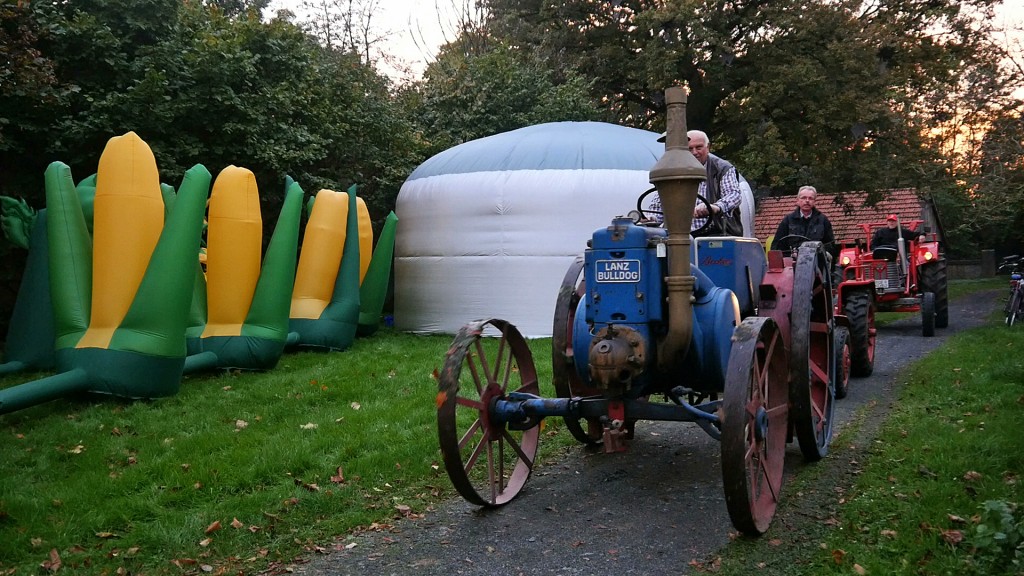
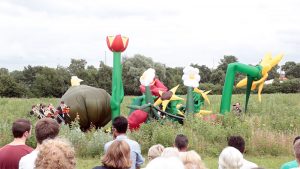
Lecture Performance at „In-Lab: FGFG A Kitchen Debate“, Jan van Eyck academie, Maastricht (NL): Nowadays, modern farmers are considered „Agro managers“. As an alternative to cultivating big fields with monocultures, big inflatable sculptures of corn, flowers and vegetables were presented to the audience, that had to help with the harvest …


„Jungle Camp“ is a sculptural media landscape of textiles and synthetics hosted in a building from the former textile industry.
This „instant-jungle” evolves and devolves as a technical biotope, performing the reappropriation of an industrial space by nature. The artificial landscape changes by changing light settings and the movements of inflatables. Sounds of growing, vivid flora and fauna create a polyphonic soundscape.
site-specific installation at the LWL-industrial museum Spinnerei / TextilWerk Bocholt, 2012
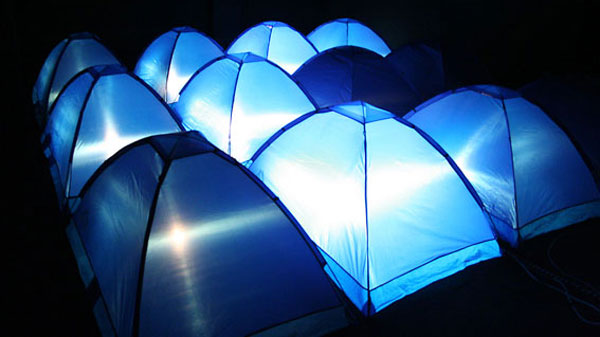
12 tents, 12 lamps, 12-channel-audio, lightcontrolers, 1 computer, custom software, dimensions variable, at least 500 x 600 x 100 cm, 2009
Camping Ensemble is a sculptural light- and soundinstallation that turns moving images like films into a generative composition. A movie is downscaled to 12 pixels on a computer. Twelve tents contain each a lamp that represents the changing lightness of each part of the movie. Parallel to the light, a sine tone in every tent is played in changing intensities. As the sine tones are in a row of connected frequencies, a (more or less) harmonic, polyphonic composition evolves and the installation becomes a kind of an abstract organ.
next / ongoing:
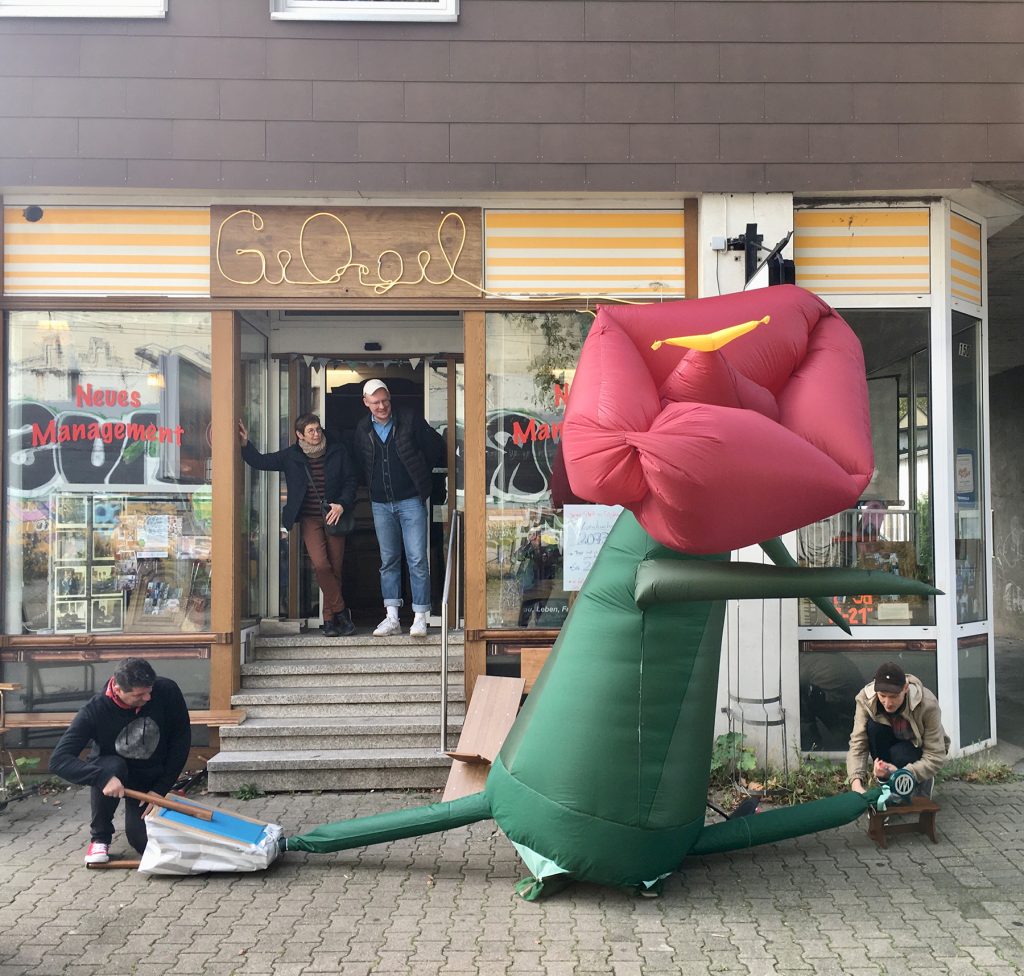
„UpCycleTheStreet!“ – inflatable flowers will blossom at Kulturpicknick at Zeche Consol (GE) on 7 and at Bobiennale from 19 to 22nd of june.
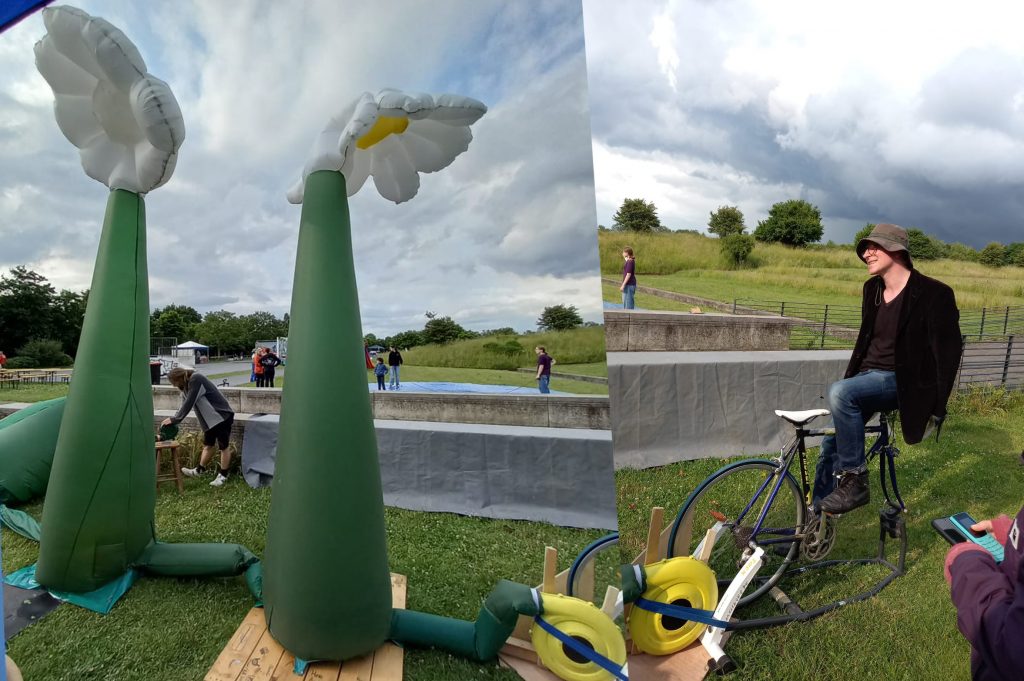
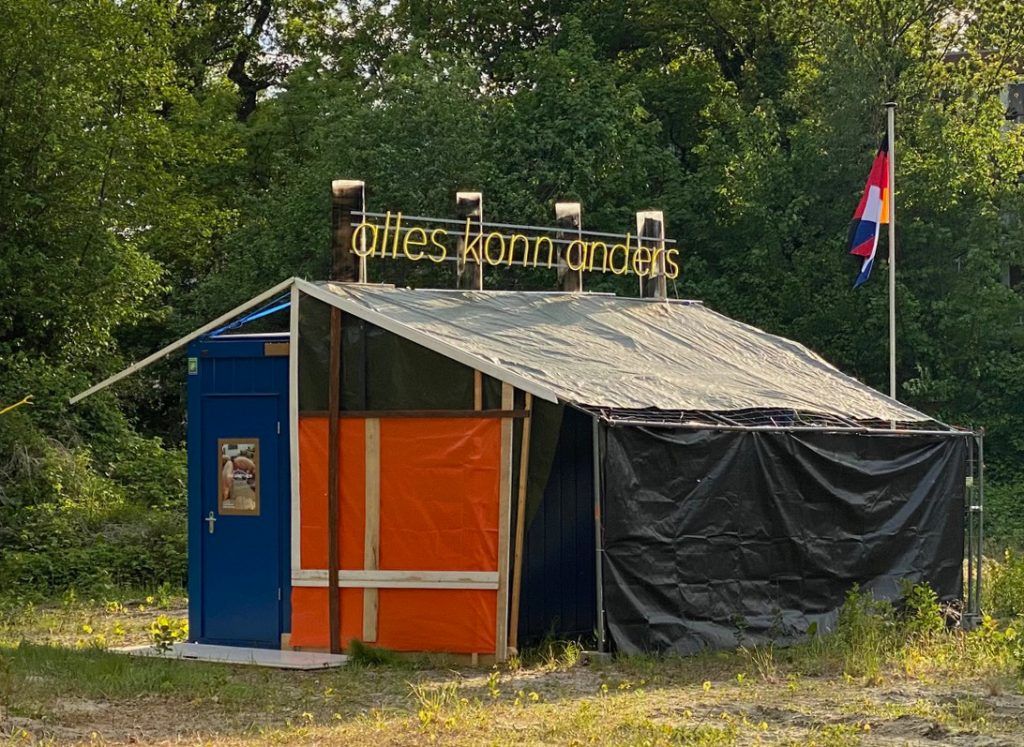
GeOrgel ’s theme in 2025 is „EinLaden“ (= a shop & invite!) with a focus on sustainable formats of a post-growth-economy as well as a series of urban interventions …

A „tulip“ (inflatable sculpture) is shown in the groupshow at Voilà Volière in Wattenscheid on march 29th.

Pig Brother (shortfilm in cooperation with Harko Wubs, 2022) will be presented by videoart_club / „Nasenrücken“ / video art screening
08.11.24 at Neuland_projektraum, Bochum, Germany

*the project DEKOLONIALWARENLADEN has been shown at the FLURSTÜCKE festival 2024 in Münster (Stadthausgalerie) and parts of the interviews are available online now here.

Pig Brother (shortfilm in cooperation with Harko Wubs, 2022) was presented at Ecozine Filmfestival in Saragossa, Spain: we went there and were happy to also present and discuss it with students.
IN ARCHIVE EINTAUCHEN (Westfalen): a videoconcert at Cinema Münster/neben*an on dec 15th 2023 at 6:30 pm & 8 pm.

IN ARCHIVE EINTAUCHEN (Westfalen) – eine Zeitreisenveranstaltung kept us busy this year: together with my colleague Michael Rieken we traveled into the archives of …

The sound- and light installation CAMPING ENSEMBLE will be presented on november 5th at the festival ANDERS! at the Wasserschloss Raesfeld; a regional film is chosen to direct 12 enlighted tents and different sine tones …
KHW&AkA – Landkultur anders is the title of our new catalogue that documents 5 years of art & music with more than 50 artists at various locations in the countryside! 176 pages, texts by Agnes Sawer, Britta Kusch-Arnhold, Stefan Demming, Graw Böckler. Book presentation jan 19th in Berlin, Kindl/Café Babette; More information (german)

the AkA – studio for cultural affairs: adventures in contemporary art and music in public space and in a former village bakery – will continue through 2023

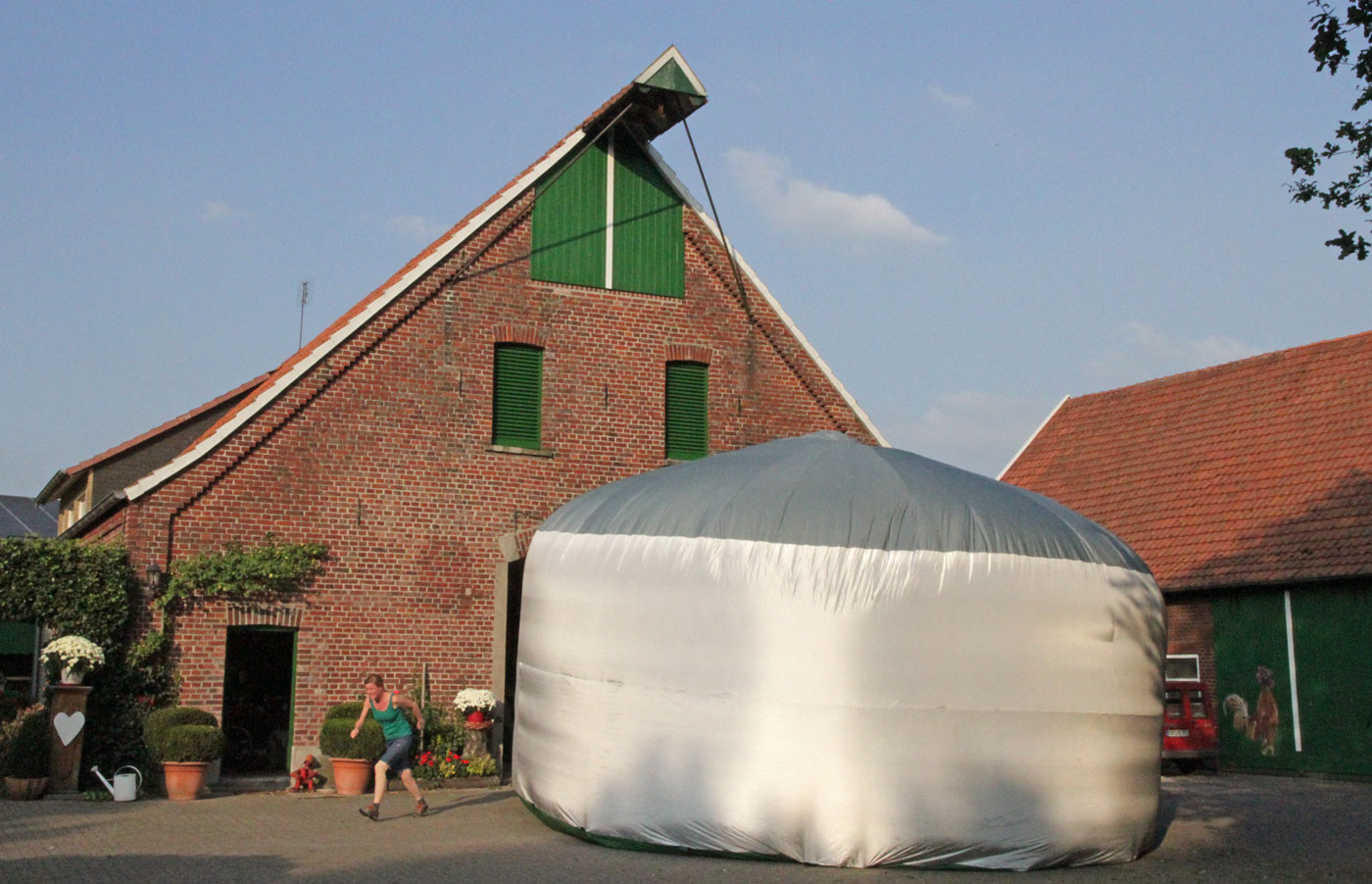
may 21st 2022: A selection of „updated landscapes“ – works on industrial agriculture as well as Germany’s first inflatable biogas plant is presented at the Mühlenhof in Münster. There will also be available an edition of the new poster for the project „Pig Brother“ (in collaboration with Harko Wubs, 2022)!
jan 13th – feb 10th 2022: The exhibition „Olymp-Reisen“ (@ FARB, Borken) gave an overview on the project HTR – home travel remember, rethinking travelling and ended with a videoconcert
jan 22nd 2022: „MEXTENSIONS„: 15 artists were invited to join a chain-video-project, premiere @ Künstlerhaus Dortmund

Gesammeltes III: Chipstüten (17.11. – 1.12.2019)
october through december 2019:
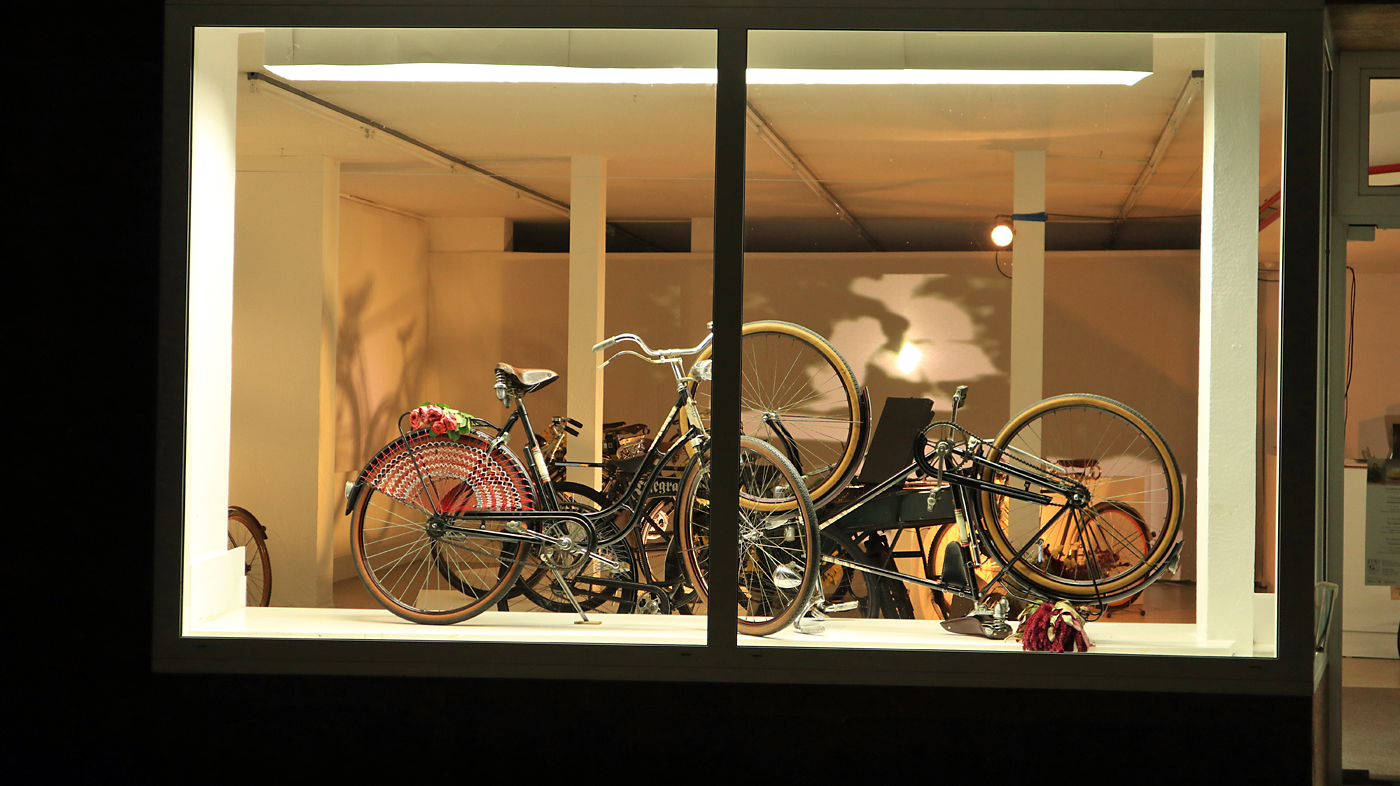
„GESAMMELTES # 1-3“ („Collected #1-3“) In collaboration with my artistic partner of Kunsthalle Weseke (KHW), Michael Rieken, we are using the private collection of things of chosen people to make a spatial light and sound installation at KHW
ONGOING (until 2020):
„Saligia–PRIDE“ – Kloster Bentlage, Rheine
***
PAST:
„regi-O-pera“, a dutch-german cross-border collaboration, has been shown in KHW and at LWL-Industriemuseum TextilWerk, Bocholt in late march 2019.
„Heimatrauschen, eine regi-O-pera“
***
Gruppenbild – 25 Jahre Klasse Guiton, Kulturkirche St. Stephani in Bremen
– 13.01.2019
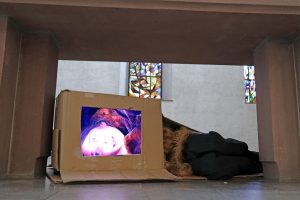 „Woman on the floor“ (2018) -> original version (in public space)
***
nov 10, 2018: POP-UP-PLANTS (WT, performance), within a kitchen debate with/by KVM, Frac Grand Large, Dunkerque (F)
***
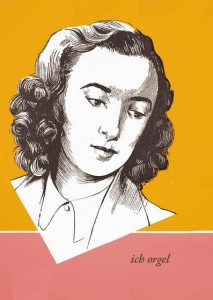
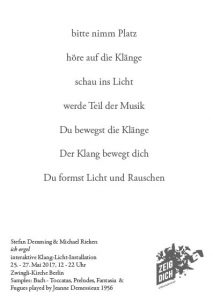
„Ich-Orgel„, a reactive-generative light- and soundorgan (installation) in collaboration with Michael Rieken will be shown for the first time at the exhibition „Zeig Dich“, DEKT Berlin, Zwingli-Kirche, may 25-27th 2017)
***
A Workshop on spactial practises at the Trondheim Academy of Fine Art on invitation of the 2017 graduating MFA class (april 20/21st 2017)
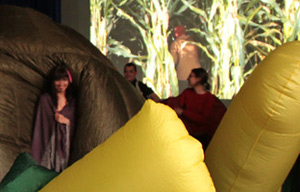
POP-UP-CORN, an Installative performance at „In-Lab: FGFG A Kitchen Debate“, Jan van Eyck Academy, Maastricht (NL) on invitation by Jessica Segall (march 16th, 2017)
***
The „Marzahn Opera“ will be open from sept 11th until october 28th at Galerie M in the very center of Berlin-Marzahn at the eastern edge of Berlin…
***
„Ein wilder Apfelbaum will ich werden“ – „I want to become a wild apple tree“, is the titel of a cooperation exhibit with Daniela Schlüter at the Rijksmuseum Twente in Enschede in the framework of Printlab SNAP3.
***
LUURN BI DE BUERN a project by Daniela Schlüter and Stefan Demming on ‚contemporary agriculture‘ is presented at Kloster Bentlage from march 15 th to april 26th. Participating artists are: Matt Arrigo, Rudi Bastiaans, Willem Boom, Marion Bouwhuis, Josh Chircop, Stefan Demming, Wapke Feenstra, Hörner/Antlfinger, Erik Kok, Petra Spielhagen, Gintare Skroblyte, Daniela Schlüter, Marc Westermann, Anna Zibler
***
The HOST, a performance by Andros Zins-Browne with an inflatable set design by Stefan Demming will be presented in HAU, Berlin on april 25th and 26th 2015.
***
a residence in Judenburg, Austria, to prepare the first LIVE-SHOW with residents of the town in the framework of THE SMALLEST SHOW ON EARTH 2 will be presented from may 16th – 25th 2014
*
PLANTAGE – PLANTATION – a series of inflatable sculptures in public space was chosen for the residency KunstKommunikation at DA Kunsthaus Kloster Gravenhorst (realized in 2013; VIDEOS: Plantation#3, Plantation#2 as an installation & performance: ,1 / 2 / 3 )
*
ELÉG is presented at dc3 art projects (Edmonton, Canada)
Selcted Stills of ELÉG build the base for an edition of prints called FRAGMENTS OF A HUNGARIAN RHAPSODY
ELÉG – a hungarian rhapsody
HD VIDEO transfered to Blu-ray, 8’17“, colour, stereo, 2012
language: hungarian with german / english subtitles …. more …
*
SPACESPACE: VIDEO documentation now online!
*
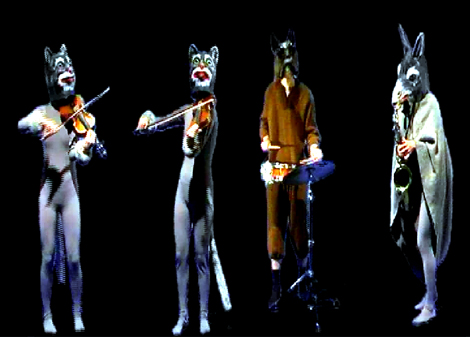
Donkey, cat, dog and cockerel are the 4 audiovisual tracks of a composition that’s generated in realtime. Due to an occasional change of the speed of each player’s performance, sound and velocity of the players are constantly changing. According to the fairy tale of the Bremen town musicians, the animals occupied the house of bandits who couldn’t bear the cacophony of the musician’s first performance.