„Videoloopmachine“ is a tool to generate audiovisual compositions from video or film footage in realtime. It operates with transformative loops and an adjustable frameset for a splitscreen. It permits to create slowly changing rhythms and offers control over 4 different video channels. It can been used to make a poetical live composition about specific topics, areas, cities and contexts. I aim to play it like an instrument and also play it together with musicians like I did with Paul Michael von Ganski who mainly helped with the programming, too.
Some more sessions with this tool include the video concerts within a project on forms of travelling
(documented journeys in a remix)
Developing / 1st(2nd) phase:
VLM – custom made software with F1-controler (concept by Demming/Rieken, programming by Michael Rieken 2016)
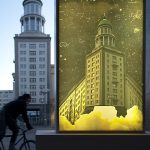
It allows to explore older movie fotaage as the basis for timebased collages and compositions. The footage for the first and proposed project comes from an east german tv-series from the 1980’s and will also be presented where it was shot in Marzahn. The district in the outskirts of Berlin is famous for it’s highrisers, that once were the most modern and comfortable housings from the GDR.
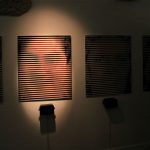
„Videoloopmachine“ is suited to produce one-channel-videos with a split screen of four in audiovisual performances. (The programming of VLM was done by Michael Rieken)
SD Video, PAL. colour, stereo, 30‘39‘‘, 2007 english / spanish, english subtitles
Since 2008, more than half of the world’s population is living in cities. The project „The edge of the city“ started 2004 as a cooperation with urbanist Wonne Ickx (Be/Mx) and became an audiovisual (re)search of the edges of Mexico City. We focussed on the people and their conditions of living there. The video combines different styles of storytelling, oscillates between documentary and essay.
It was the startingpoint for a series of works dealing with the idea of an endless cityscape.
The Edge of the City – text by Ruth Estévez
Stefan Demming’s artistic practice is a practice of travel. In his work he fosters the observation of daily scenarios to narrate different kind of human adventures. Throughout his voyages, the artist is recording with his video camera his appeal to moments and landscapes emphasizing concrete situations, which become in the very process of documentation independent and unique accounts.
By using maps and imaginary routes, Demming searches for places and spaces, where he sometimes takes their more obvious and literal function while other times he metaphorically alters their order, constructing adventures which give inner sense to what’s been previously recorded; it is this same sense that the traveler transforms his actions into epic poems regardless of the triviality of the facts exposed.
The exhibition entitled El límite de la ciudad (The Edge of the city) is based on the artist’s documentary with the same name, filmed in 2004 while visiting Mexico City. The video oscillates between document and fiction in order to narrate Demming‘s trip with urbanist Wonne Ickx, in search of the unpredictable limits of the metropolis.
From the start, there is no intention of revealing the actual limits of the city. Rather, the artist chooses to fantasize about the mysterious limits that appear to be never ending. This way all the research turns into a novel, moving towards a theme of the protagonists’ travels and adventures while at the same time revealing the conditions of survival based on the improvised reality that surrounds them.
To achieve the task, the artist becomes an ambiguous mixture between traveler and cartographer (a concept that may seem contradictory at first). The journey1 (something the cartographer doesn’t trust, even to the point of hating it) will be constructed from an imaginary relationship between the gaze and the landscape, camouflaged by the intention of finding the geographic demarcation of the city.
Throughout various interviews conducted in random encounters with strangers, the artist receives some kind of confirmation regarding the supposed limits of the city, which he then decides to disregard in an attempt to keep them unknown. Demming prefers to contemplate (in an almost Baudelaire-esque2 fashion) the urban horizon, marking a subtle difference between everyday functionality and the creation of myths.
It is through these excerpts that the exhibition reviews moments (personal anecdotes or stories told by others), spaces and daily activities that together reveal the possibility of urban boundaries.
Simulations, almost theatre sets- videographical or sculptural- which allow the optical illusion of the infinite, the structuring of the unimaginable and above all, the feeling of uncertainty and instability that comes with this changing geography.
Ruth Estévez
1 The notion of “a journey” is forged as one in the romantic sense of 19th century travelers, where the “real landscape” (perceived as something controlled and humanized) is replaced by the “sublime landscape”, which excites and provokes surprises or wonder.
2 Contrary to the first German Romantics where the poetic landscape was primarily constructed from nature, Baudelaire’s poetic landscape could have only been the city, the 19th century metropolis and its anonymity, its size and its misery.
Audiovisual composition is an orchestration of moving images and sounds. It can be a collage of findings and generated imagery or a visual journey based on playful editing and dramatization. Some of them I’d like to call timebased paintings, most of them focus more on sound and images than a narrative story. Find some selected AV Compositions (since 1999) below:
HD-video on BLU-RAY, 29’20’’, Pal, colour, stereo 2009
Language: Lowgerman, English, Pidgin; english subtitles
Sister Bernard Overkamp was a missionary sister in Papua New Guinea from 1968 until 1993. After 25 years she stopped her mission there because she thought the local sisters could do even good without her and she „didn’t want to be a hindrance for they cannot live their own culture.“
Since the year 2000 she and her colleague sister Dorothy are travelling with a circus in the USA. As an employee she takes care for the costumes of the female dancers. She and sister Dorothy want to be among the people and accompagny them. They call it a „ministry of presence“.
The video has been shown as a part of an installation project in public space: in camper that’s part of THE SMALLEST SHOW OF THE WORLD 2. By this, the story of the two nuns is brought back on the road and to the people.
HDV (transfered to Blu-ray), 8’17“, colour, stereo, 2012
The Budapest bathing culture is a rich cultural heritage. But while inside, there’s mainly tourists swimming, dissonant sounds from outside seem to disturb the flow of images …
On observing people’s bathing in different baths of the hungarian capital, a speech from the off is heard: Balázs Nagy Navarro talks on occasion of a hunger strike agains media manipulation in public media in december 2011.
The rhapsody as a poetic composition refers to the „good old times“ that seem to be preserved in the baths of Budapest. Many residents can’t afford regular visits of the Széchenyi or Gellért bath while Lukács is mainly frequented for curatorial reasons.
The recordings were made in 2009 and 2010 at different seasons. The idyllic image of the baths doesn’t seem to be more distorted by the modernization to wellness temples but by the changed political situation in the country.
Not only since the controverse media laws of Orbán’s government there’s international worries about the future of democratic freedom in the country.
Navarro and others protested against a singular case of manipulated reporting as well as the media policy of the rightwing Fidesz-government in general.
As a consequence of this protest Navarro, who was previously employed by the channel that he protested against, has been suspended from his work.
In his speech as well as in the sentimental goodbye-song at the end of the video the word „ELÉG“ is central: it is ENOUGH.
NOTES ON THE PRODUCTION:
The footage was shot in companionship with photographer Julia Baier (juliabaier.de) who’s focussed on public bathing culture. The video was finalized in 2012 in exchange with the hungarian activists Gabriella Csoszó (photographer) and Lídia Nádori (translator and musician).
Recorded at these baths of Budapest:
Széchenyi, Gellért, Lukács, Palatinus, Komjádi, 2009 – 2010
speech: Balázs Nagy Navarro
sound recording: Gabriella Csoszó (gabriellacsoszo.com)
translation: Éva Zádor (hungarian to german), Fabian Baier (german to english)
Thank you:
Balázs Nagy Navarro, Lídia Nádori, Gabriella Csoszó,
Julia Baier, Éva Karádi, Éva Zádor, Astrid Nippoldt, Fabian Baier,
the public baths of Budapest who gave permission for the shooting
„SPACE SPACE“ is a choreography of audiovisual events based on cinematographic scenarios of outer space.
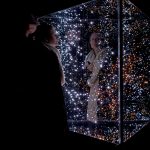
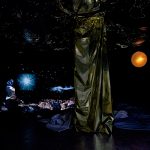
Endless Stars
lunar landscape
the rocket …
The tower-rocket …
One of six astronauts
A choreography of audiovisual events, Galerie im Turm, Berlin 2012
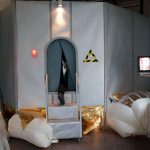
SPACESHIP: 12-channel-audio, video projection, 4 blowers, inflatables, spotlights, 6 photographs mounted on aluminium (80 x 100 cm), wood, paper, readymades, fabric, foil, 1 painting (100 x 120 cm), 2 monitors, light controlers; 2 computers with custom software, duration: part I(Spaceship): 5’23“
LUNAR LANDSCAPE, video projection, loop 5’38“ &
SCULPTURE „Endless Space“: 3 mirrors, 2 2-way-mirrors, 240 LED-lights, iron construction, 2012
For six weeks the Galerie im Turm was transformed into an accessible space scene. The installation „SPACE SPACE“ by artist Stefan Demming is a media landscape based on early visions of space travel. Set designs of older sci-fi movies and space stereotypes create a staging that invites the visitors of the gallery on a galactic journey of discovery. In the sculpture „Endless Space“ the fascination of infinity and therefore the own perception are explored …
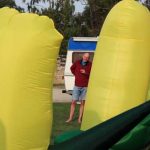
Installation, 2013
1 Videoprojektion (Loop), 5-Kanal-Audio, Aufblasskulpturen, Gebla?se, Textilen, Pappe, Spots, Ventilator, Bewegungsmelder
In einer dschungelhaften Kulisse aus synthetischen Materialien liegt ein nackter Mann wie tot in einem Fluss. Wenn Besucher sich ihm na?hern, blasen sich Pflanzenskulpturen in der Kammer auf.
( Kunstkammer Schlieren im Rahmen SAME(difference)_sculpture in relation
kuratiert von/curated by: Tanja Trampe, Anne Koskiluoma, John Canciani, Nkule Mabaso)
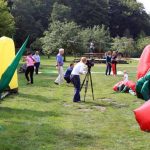
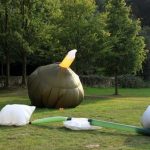
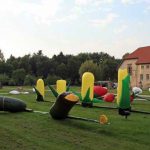
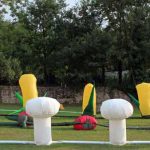
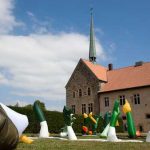
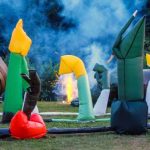
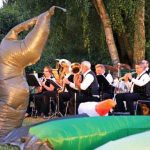
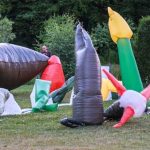
PLANTATION (PLANTAGE) consists of a growing number of inflatable plants, the project’s background is industrial agriculture. It grows series of plasic fruit, readymades as well as custom made forms. It explores temporary sculptural forms in their growing and declining process. The ephemeral sculptures were occasionally presented with live music made with wind blowing instruments (which is in german „Blas-musik“ while the inflatables may be called „Auf-Blas-Skulpturen“).
Agriculture in Europe has changed a lot within the last decades and years. Like with other plants, the harvest of corn is done with big machines. A girl with a microphone gets lost in the cornfield. A farmer looks at his plants. They are all in a cornfield, the parallel montage evokes some dramatical stories, but the film is mainly about observing the harvest and the change of the landscape.
Dialogues:
(Elderly farmer from the off in Low-german)
This belongs to the farm of
Borkmann and is rented out.
There is also no follower
on that farm.
The main house is rented,
some families live there.
At last everything is changing
in the farming business …
The harvest has been accompagnied with a camera and besides the big machines, I started to film the camera assistant who enjoyed listening to the sound of a cornfield for the first time. If you have ever been in a cornfield you can imagine that it’s not always easy to find your way out – it’s like a djungle! However, the sound of the big harvesting machines cannot be overheard, unless you’re completely into something else…
A motivation for making the video was to document the big change of the landscape: while from midsummer on, you cannot see very far anymore due to the highth of the corn, after the harvest you suddenly can look very far. Suddenly, you see farms and a horizon where there used to be a „green hell“ like some people say. Allthough corn as a plant has only been cultivated since 50 years in the region Münsterland (close to the dutch border), it nowadays covers about 50% of the surface of the region. This is due to the growth of animal production: stables with hundreds of cows or even thousands of pigs need a lot of food! As still new stables for even more animals are being built, it is harder to get land for growing food for a farmer. And renting land has become more and more expensive of course. As a consequence, farmers need to expand or quit farming. Invest or stop. The number of farmers decreased a lot wihtin the past decades for different reasons. But the growing concurrence within an industrialized agriculture makes the farmers become ‚agro managers‘.
(D; Videoloop for upright monitor 2’51′, col, stereo, 2011)
A woman in a yellow dress with an opulent hat and a black veil is standing in front of a pink background and sings something in french. But her words are hardly comprehensible because she’s singing back and forth, her movements have been sampled. By this she’s getting something mechanical and becoming a singing sculpture with rhythm. Transformative loops turn the parts of words and syllables into new variations of melodic sequences and in between one could maybe decrypt her message: „Nous sommes dans une situation difficile.“- „We’re in a difficult situation.“
In the original movie, the woman is asking for credit from a money lender. In it’s remixed version the chanson is turned into techno.
Like in an earlier work (Les Paraparapluies, 2009) the footage is taken from the movie ‚Les Parapluies de Cherbourg‘ (F/D 1964) by Jacques Demy, that fascinates me in a special way.
Even more remixes can come out of this fascination. The reasons are founded in the unique decor with its sweet esthetics and the brilliant combination of a tragic lovestory with a socially critical background. Last but not least it’s the form of a the musical that makes it intriguing to resample the emotional and expressive, singing faces.Footage: Les Parapluies de Cherbourg (F/D‚ 1964)
director: Jacques Demy, music: Michel Legrand-
(deutsch)
PARAMADAME(D; Videoloop für hochformatigen Monitor 2’51′, Farbe, stereo, 2011)Eine Frau im gelben Kleid, mit opulentem Hut und schwarzem Schleier steht vor einem rosa Hintergrund und singt etwas auf Französich. Doch ihre Worte sind nur sehr schwer verständlich, denn sie singt vor- und rückwärts, ihre Bewegungen sind gesampelt. Dadurch erhält sie etwas Maschinelles und wird zur rhythmisierten Singskulptur. Aus Satzteilen und Silben entstehen durch die transformativen Loops immer neue Variationen von melodischen Folgen und zwischendrin kann man unter Umständen einen Teil Ihrer Botschaft entschlüsseln: „Nous sommes dans une situation difficile.“- „Wir sind in einer schwierigen Situation“. Im originalen Film bittet die Frau beim Pfandleiher um Kredit. In seiner ge-remixten Version wird das Musical vom Chanson- zum Techno-Ohrwurm.Wie bereits bei einer früheren Arbeit (Les Paraparapluies, 2009) entstammmt das Ausgangsmaterial dem Film ‚Les Parapluies de Cherbourg‘ (F/D 1964) von Jacques Demy, der mich in besonderer Weise fasziniert und mit dem noch weitere Remixe entstehen können. Gründe dafür liegen in dem einzigartigen Dekor und seiner süsslichen Ästhetik sowie der genialen Verbindung einer tragischen Liebesgeschichte mit sozialkritischem Hintergrund. Besonders aber reizt mich die Form des Musicals, die es erlaubt, die emotionalen und expressiven singenden Gesichter zu resampeln.Footage: Die Regenschirme von Cherbourg (OT: Les Parapluies de Cherbourg; F/D‚ 1964)
Regie: Jacques Demy, Musik: Michel Legrand