An ongoing research and performance project of audiovisual compositons based on an archive of urban registrations from the 1950’s to the 1990’s.
Composition / extracts of a performance at Studio GeOrgel.
Thanks to the city of Gelsenkirchen and the institute for the city’s history (ISG) for the permit to use the material, made possible with the financial help of the city of Gelsenkirchen and the LWL-Kulturabteilung as well as the kind permission to research the archive of home movies of the Ruhr area by the RVR.
Aus ausgewählten Archivbeständen einen performativen Zeit-Raum als Videokonzert und/oder Installation mit Mehrfachprojektion und Live-Audio zu entwickeln ist das Anliegen dieses Projekts künstlerischer Forschung. Die rhythmisierten Streifzüge zeigen ausschnitthaft und in wechselnden Setups, wie Westfalen und vor allem die Region Münsterland „früher“ aussahen. So war die Landschaft beispielsweise von ausgedehnten Moorgebieten geprägt, deren Umbau zu Ackerflächen in einem Film aus den 1960er Jahre veranschaulicht wird. S. Demming erzeugt dafür mit einem 4-Spur-Videosampler live eine audiovisuelle Kompositon aus transformativen Loops mit unterschiedlichem Footage aus 90 Jahren. (mehr Infos s.u.).
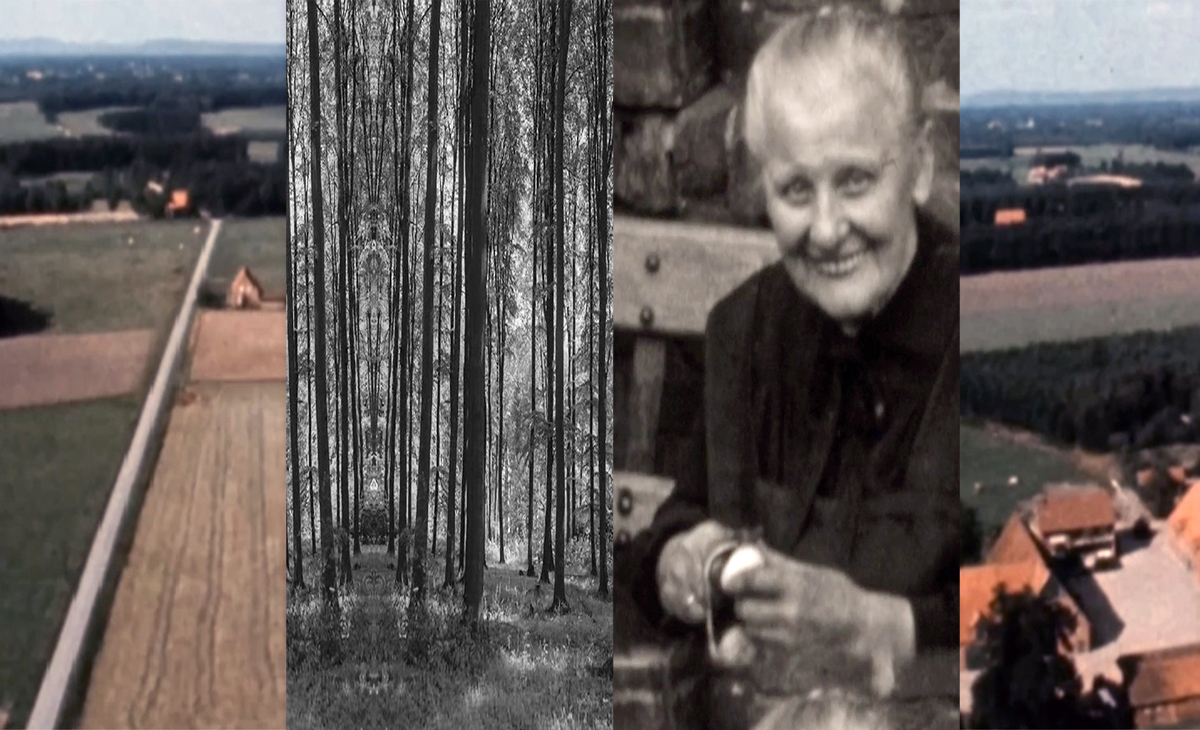
„In Archiven“ – Videocollage (still, SD), footage: Hermann Reichling, 1938
Während Michael Rieken sich intensiv mit ausgewählten Fotos des Naturschutzpioniers und Naturfotografen Hermann Reichling (1890 – 1948) auseinandersetzt und Audios aus einem Tierstimmenarchiv für Soundscapes nutzt, konzentriert sich Stefan Demming auf filmische Zeugnisse Reichlings und denen einiger weiterer Filmemacher. Neben „Kulturfilmen“, die die Region beschreiben und bewerben sollten, zeigen Amateurfilmer vor allem den Alltag: aus heutigem Blickwinkel betrachtet, erscheint das Dorfleben noch „ursprünglich“, der industrielle und technische Fortschritt eine Errungenschaft, spätere Entwicklungen und Folgen der intensiven Nutzung des Landes sind noch nicht im öffentlichen Bewusstsein. Die Archivfunde sind auch Zeugnisse des technischen Stands ihrer Zeit und verweisen auch auf die Intentionen ihrer Produzent:innen.
Das Projekt „IN ARCHIVE eintauchen (Westfalen) – eine Zeitreisenveranstaltung“ basiert vor allem auf Recherchen in den Archiven des LWL- Medienzentrums sowie des LWL-Archivs für Alltagskultur in Münster. Hinzu kommen in Westfalen angefertigte Klangaufnahmen aus dem Tierstimmenarchiv des Museums für Naturkunde Berlin sowife Bewegtbilder und Klänge aus dem eigenen Archiv der Künstler.
6.+7.10. 2023 im DA Kunsthaus Kloster Gravenhorst,6.+7.10. 2023 im DA Kunsthaus Kloster Gravenhorst,6.+7.10. 2023 im DA Kunsthaus Kloster Gravenhorst,Dorfszene, Nottuln 1950Dorfszene Ramsdorf 1969Dorfszene, Nottuln 1950Reichling Wald (Filmstill, MR)Reichling Wald (Filmstill, MR)Reichling Horizont in der Bearbeitung von MR (Ausschnitt)auf Schloss Sendenauf Schloss Senden„In Archiven …“ – Projektion in einen alten Kamin von Stefan Demming, Schloss Senden„In Archiven …“, Installationssichten und Stills aus unterschiedlichen Filmen aus dem Archiv des LWL-Medienzentrums (bearbeitet)
Zwischen begehbarer Installation, medialer Oper und Videokonzert sind Besucher:innen eingeladen, das sich oft veränderte Setting bei einer Tasse Tee zu erleben. In unterschiedlichen Tempi und Wiederholungen komponieren Demming & Rieken bewegte Klang-, Landschafts- und Menschenbilder in einem sich wandelnden Zeitfluss. Dabei werden die Bestände meistens in Ausschnitten und Bearbeitungen präsentiert. Im Fokus stehen weniger Aspekte der lückenfreien Dokumentation und wissenschaftlichen Objektivität, sondern vielmehr die subjektiv-eklektische Auswahl und der ihnen zugedachte Rhythmus.
Trailer zu „IN ARCHIVE eintauchen“ (Westfalen), weitere VLM-Remix-Beispiele s. unten.
„Aus den medialen Zeugnissen der regionalen Vergangenheitentwickeln wir eine audiovisuelle Reise. Können wir aus der Vergangenheit lernen – bricht das „gute Leben“ zusammen, wenn wir einen Teil unseres Wohlstandes aufgeben? Wie reich erscheinen wir, wenn wir die Entbehrungen früherer Epochen bedenken! Welche aktuellen Praktiken wären in der Vergangenheit oder in einem Archiv besser aufgehoben?“
Demming & Rieken arbeiten mit Unterbrechungen seit 2001 an verschiedenen audiovisuellen Installationen und Projekten künstlerisch und kuratorisch zusammen, zunächst an der HfK Bremen, seit 2018 auch an einer „LandKULTUR – anders“ in der KHW (bis 2020) und dem AkA (aktuell).
Intro basierend auf Footage von Hermann Reichling, der 1938 Vögel im damals noch grösseren Münsterländer Moor beobachtete.
Remix mit VLM – VideoLoopMachine, Footage aus dem LWL-Medienzentrum, Filmnummer 19 „Wie die Zeit vergeht“, Amateurfilm mit Sterbeanzeige des Priesters Wilhelm Hackfurth vom 30.06.1961 abgefilmt
Nottuln, 1950 bis 1952, von Johannes Weber aufgenommene Szenen rund um das Dorf, den Alltag, die Freizeit: zwei kurze Einstellungen eines Waldspaziergangs in amateurhafter Aufnahmetechnik sind weiter ineinander verwoben und dienen im Projekt als Teil einer raum-zeitlichen Inszenierung. „Eine Episode nur“, Videoskulptur/Loop mit Footage aus „Schicksale einer Landschaft“ (1958)
EN
Archival Ramblings: TimeTravel on october 6th&7th 2023 at DA Kunsthaus Kloser Gravenhorst; oct 20th at Schloss Senden
We are developing a performative space with multiple projections, live audio and changing setups. The forays into selected archives show excerpts of what the Münsterland region looked like „in the past“. There were many moors here, for example, whose conversion to farmland was described in a 1960s cultural film. Village life still seems original, industrial and technical progress an achievement. In different tempos and repetitions, moving images of landscape and people are composed in a changing flow of time. The archival finds are also evidence of the technical status quo of their time and also point to the intentions of their creators. Between walk-in installation, media opera and video concert, visitors are invited to view them with us over a cup of tea.
Stefan Demming’s collaboration with Michael Rieken (and possibly others) is based on research in the archives of the LWL Media Centre and the LWL Archive for Everyday Culture in Münster.
„From this we develop an audio-visual journey into the past… Can we learn from the past – does the „good life“ collapse when we give up part of our prosperity? How rich we appear when we consider the deprivations of previous eras! What current practices would be better off in the past or in an archive?“
Frozen moments, 5’53’’, DV, col, stereo, PAL, 2002; music: Jan van Hasselt
A group photo at a baptism is stopped in the moment the flash goes off. A video about photography as a ritual and the simultaneity of speed and stillness of the electronic image. Everybody tries to look good for that moment, hoping to look good for eternity.
„See also texts of Frauke Ellssel and Elke Bippus on this work.
7’, dv, col, stereo, PAL, 2001; music: Tim Tetzner, Stefan Demming
At a crossroad in Poland pigeons and people start to tremble in repetitive loops: a series of single frames in fast repetition with only small variations. You are at the red light: „Please wait!“
A tourist is posing for the image at different places in a village by the seaside. Finally something happens, a drowning girl and a rescuer with a mask play a role in fragments of a story.
Depending on the amplitude of the music, the image is constantly cut into stripes of changing sizes.
The video Weltuntergang shows a thunderstorm through an open window. The lightnings are edited in a way that they appear quickly after each other. In addition, there‘s artificial photoflashes that illuminate the inside of the room. The flashes cause interferences that make the image on a crt display seem to tremble. When printed as a still image, this creates light stripes.
Based on the film „Les parapluies de Cherbourg“ by Jacques Demy (1964) an audiovisual composition evolved that reduces the narrative elements of the original movie by turning short sequences into transformative loops. As all dialogues in the original were sung, the repetitions create melodic rhythms. In synchronized beats, the sampling of the sound goes along with the visual rhythm of the composition. The actors look like virtual singing sculptures and the grammar of the movie can be examined.
12 tents, 12 lamps, 12-channel-audio, lightcontrolers, 1 computer, custom software, dimensions variable, at least 500 x 600 x 100 cm, 2009
Camping Ensemble is a sculptural light- and soundinstallation that turns moving images like films into a generative composition. A movie is downscaled to 12 pixels on a computer. Twelve tents contain each a lamp that represents the changing lightness of each part of the movie. Parallel to the light, a sine tone in every tent is played in changing intensities. As the sine tones are in a row of connected frequencies, a (more or less) harmonic, polyphonic composition evolves and the installation becomes a kind of an abstract organ.
The „Marzahn Opera“ re-animates some figures from an east-german tv-soap opera that was shot in the just built highrisers of Marzahn in Berlin’s very east in the late 1970’s. In an architectural setting that ressembles east-german highrisers, some scenes from „Einzug ins Paradies“ (moving in paradise, 1985) are appearing. The actors seem to stutter rhythmically: the sampled footage forms an electronic choir of everyday life and philosophical thoughts. The characters are sampled in short transformative loops so that their repetetive language turns into some kind of an electronic rap …
A roadmovie concert for splitscreens of four, each part showing extracts of a video-diary in a staggered way: present, past and future appear simultaneousley and side by side.